
Mandate
Institutional portfolio operations
Portfolio implementation and control, made traceable.Mandate reconciles fragmented portfolio data, evaluates effective-dated controls, and produces an auditable path from rebalance intent to authorized handoff.
- Status
- Synthetic product concept
- Role
- Systems design and build, solo
- Stack
- Next.js · TypeScript · Zod · Vitest
- Affiliation
- Independent. No firm, no client data
The product
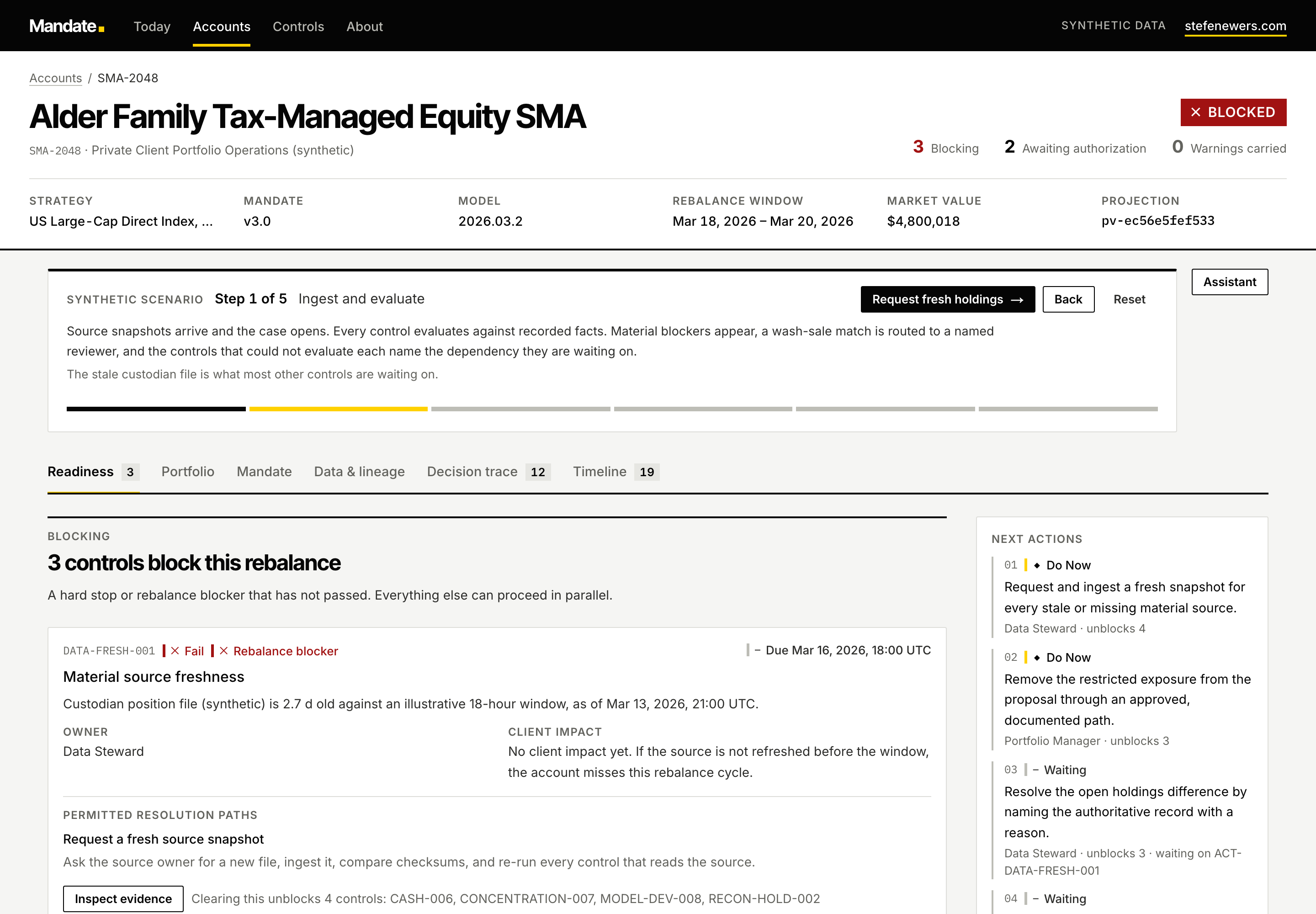
- 01
Readiness
Blocked · 3 controls
- 02
Blocking control
DATA-FRESH-001 · Fail
- 03
Evidence
Source 2.7 d old vs an 18 h window
- 04
Next action
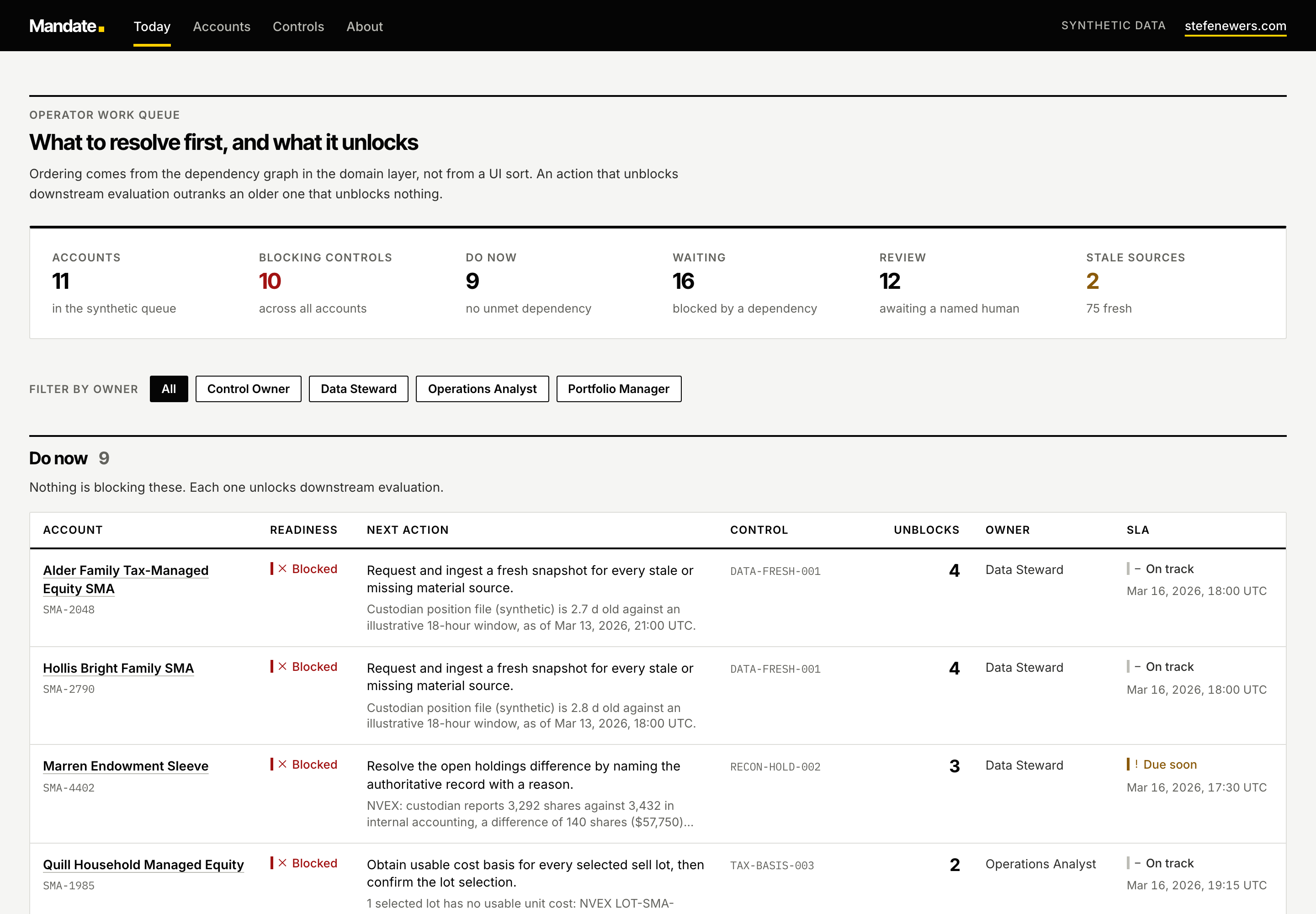
Owned, and it unblocks 4 controls
The problem
The answer is spread across seven systems.
Material sources
- Custodian holdings
- Internal accounting
- Model portfolio
- Security master
- Mandate document
- Tax-lot ledger
- Transaction history
MANDATE.
Reconcile · evaluate · order · authorize
One canonical account state
Recorded facts · append-only events · one derived projection
A rebalance decision depends on facts distributed across custodians, policy documents, tax context, model data, and human approvals. Readiness gets asserted because reconstructing it is slower than the trading window. Mandate makes the reconstruction the product.
The product insight
An account is not ready or not ready by opinion.
Readiness is derived.
Facts
Recorded, sourced, timestamped
Effective-dated controls
Versioned policy, not opinion
Dependencies
What must be trusted first
Human authority
Who may release, and against what
The current mandate state
Re-derived on every new fact · never edited by hand
Blocked, and why
Blocked
3 unresolved controls
DATA-FRESH-001
Custodian position file is stale against its freshness window
MANDATE-RESTRICT-004
A proposed buy conflicts with a verified client exclusion
TAX-BASIS-003
A selected sell lot has no usable cost basis
Mandate does not simply flag the portfolio. It exposes which control failed, the evidence behind it, the policy version in force, the required resolution, and who must authorize release.
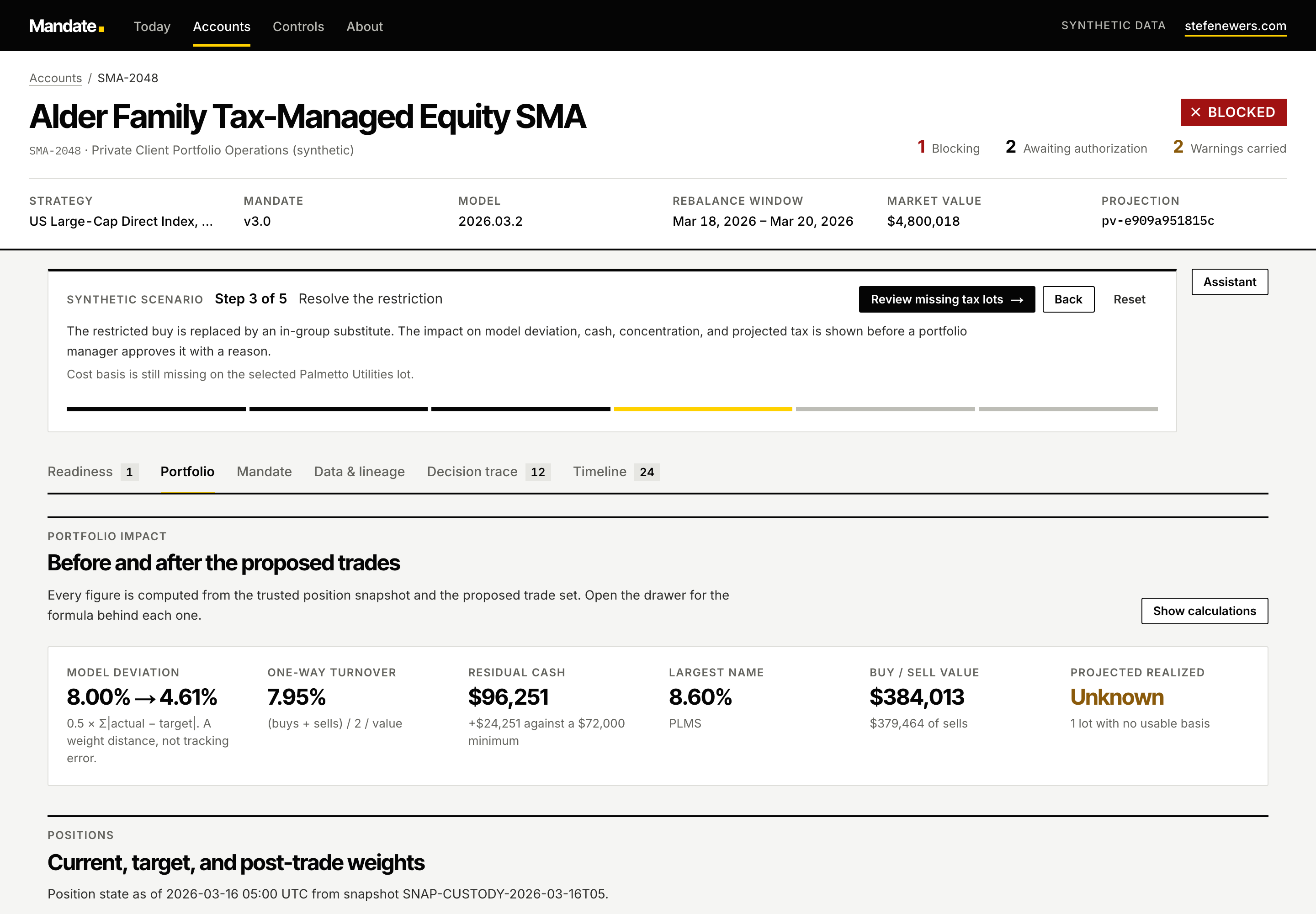
State transition
Same account. Same policy. New evidence. New state.
- 01
Blocked
3 unresolved controls. 5 more report they could not evaluate and name the dependency they are waiting on.
Fresh source ingested, authoritative record named
- 02
Needs authorized review
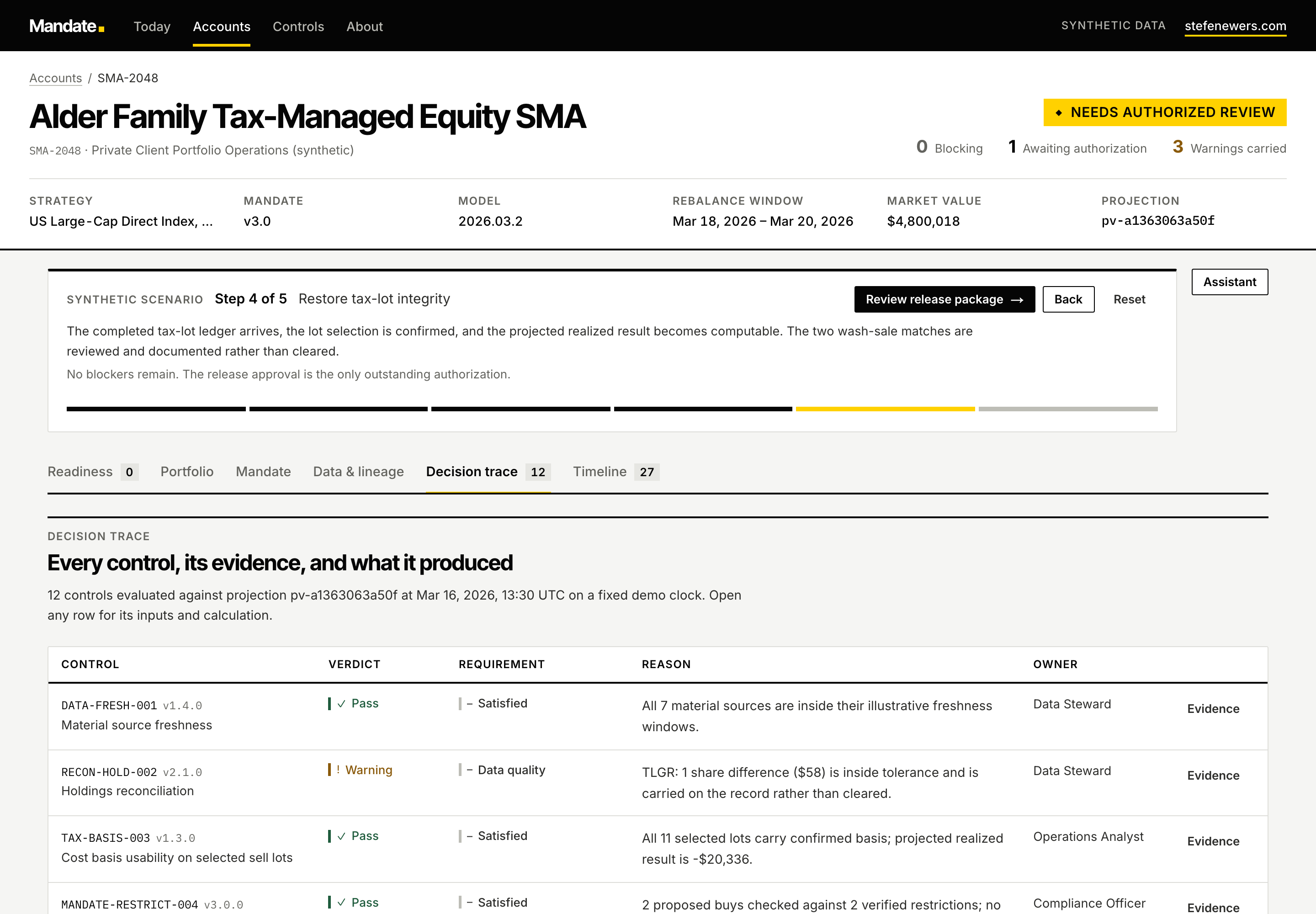
No blockers remain. Three warnings are carried on the record rather than cleared, including a documented wash-sale review.
Portfolio manager authorization, with a reason
- 03
Handoff approved
A checksummed synthetic package bound to one exact projection version. It says approved. It never says executed.
Each step appends real domain events and re-runs the same projection. Readiness changes because the facts changed, not because a screen advanced.
Control trace
One control, and everything behind its verdict.
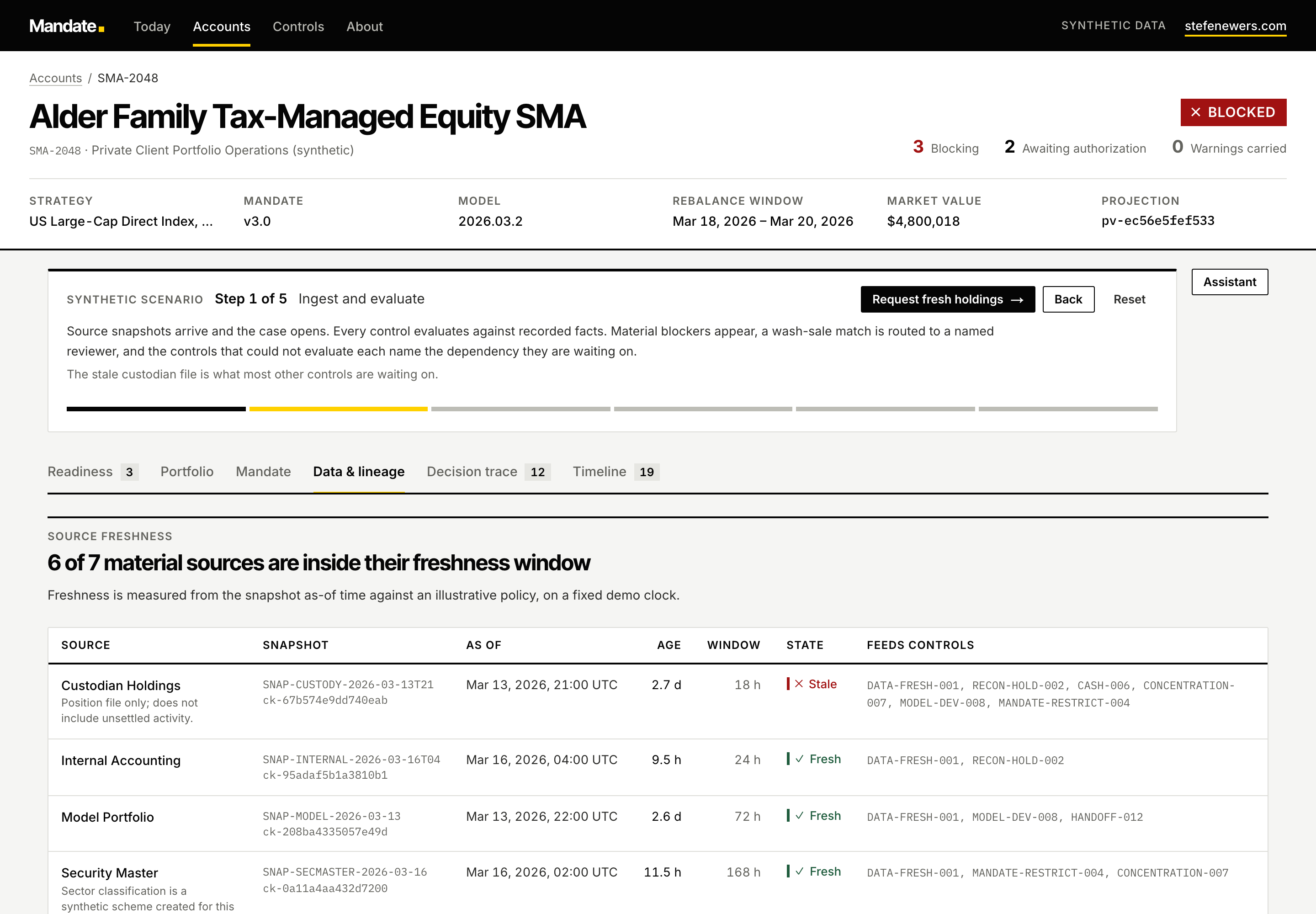
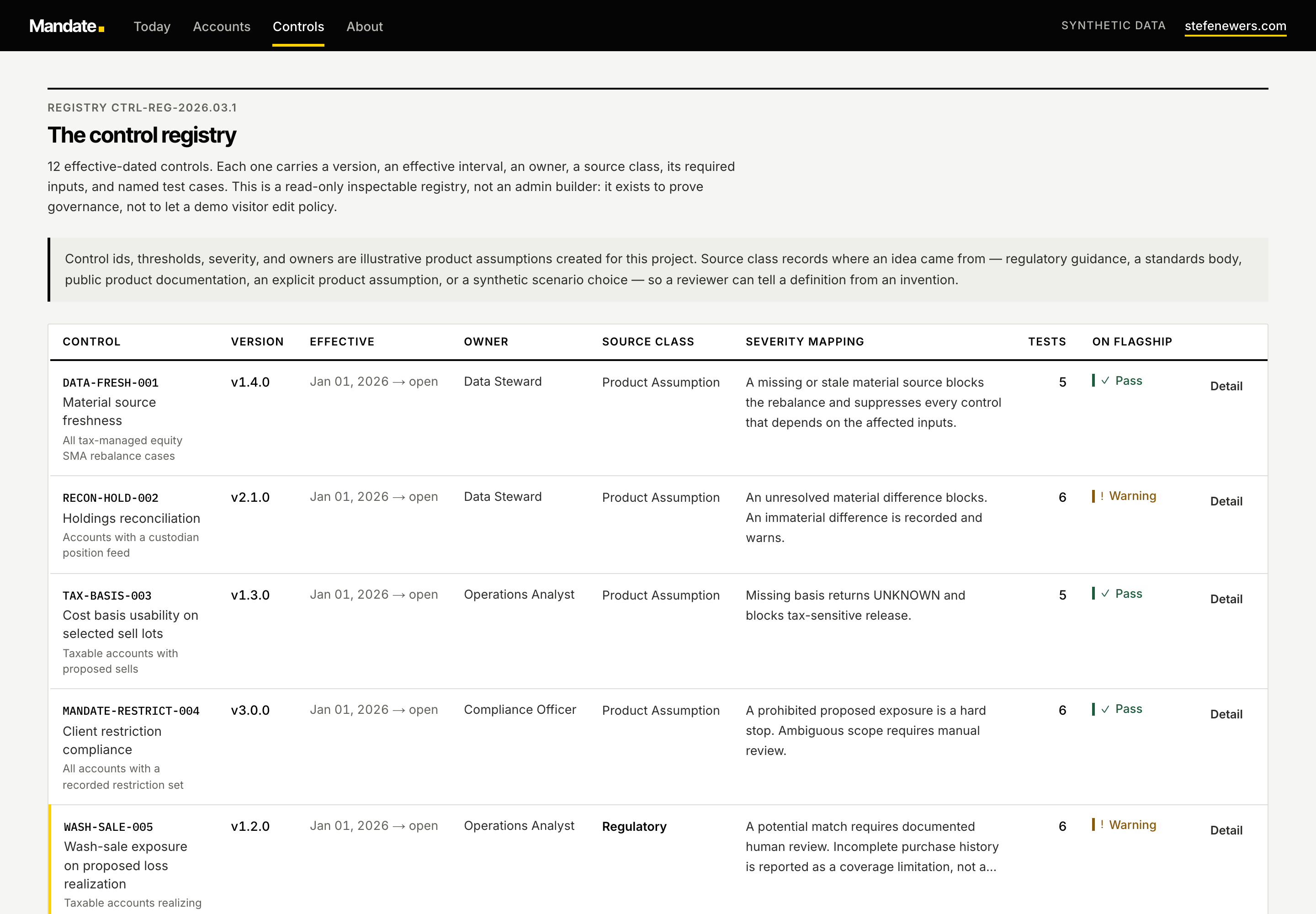
The blocker that most other controls on this account are waiting on, as the product publishes it.
- Control
- DATA-FRESH-001Material source freshness
- Version
- v1.4.0Effective Jan 01, 2026 → open
- Verdict
- FailRequirement: rebalance blocker
- Input
- Custodian position fileAs of Mar 13, 2026, 21:00 UTC
- Measured
- 2.7 days oldAgainst an 18-hour window
- Source class
- Product assumptionIllustrative, not any firm’s policy
- Owner
- Data StewardResolution is owned, not unassigned
- Next action
- Request and ingest a fresh snapshotClearing it unblocks 4 controls
- Authority
- Release requires a portfolio managerBound to the resulting projection
Verdict and requirement are separate axes. The same finding can be a hard stop under one mandate and a warning under another, which is why the catalog records both.
How it works
Reconcile. Control. Authorize.
- 01
Reconcile
Fragmented evidence becomes one canonical account state, with every fact carrying its source and age.
- 02
Control
Effective-dated deterministic rules evaluate readiness. Unknown stays unknown; a contradiction stays a contradiction.
- 03
Authorize
A named human releases material action, bound to the exact projection they reviewed.
Architecture
Facts are recorded. Decisions are derived. People release.
- 01
Source data
Seven material feeds, each with an as-of time and a checksum
- 02
Canonical account state
Recorded facts and an append-only event log. Nothing derived is stored
- 03
Control engine
Versioned, effective-dated, dependency-aware
- 04
Readiness
Derived, never asserted
- 05
Resolution plan
Ordered by what each action unblocks
- 06
Authorized handoff
Checksummed, projection-bound, synthetic
Scope
What is built, and what is stood in for.
Built
- Canonical, event-sourced account state
- Deterministic control evaluation
- Effective-dated, versioned rules
- Event replay and deterministic reset
- Dependency-aware resolution planning
- Reproducible decision trace
- Projection-bound approvals and invalidation
- Checksummed handoff state
Simulated
- Custodian and accounting feeds
- OMS and execution venue
- Tax system integration
- External compliance tooling
- Named approver identities
Implementation
Under the hood.
- Canonical state
- One normalized source of truth for the rebalance case. It stores facts and events, never readiness.
- Projection engine
- Readiness is re-derived from the current event state and an injected clock, never mutated by hand.
- Effective-dated controls
- Each rule carries a version, effective interval, scope, owner, source class, and named tests.
- Append-only events
- Every past decision stays reconstructable, and reset rebuilds an identical baseline.
- Decision trace
- Every material outcome links to its evidence, rule version, result, and the human who acted.
Boundary
What Mandate does not do.
- Optimize portfolios
- Route or execute trades
- Replace the order management system
- Act as a tax engine
- Let AI override a control outcome
The boundary is the product decision. Models propose trades, controls evaluate readiness, authorized people release the handoff. The handoff is a synthetic package, never an order.
Why it exists
A control problem, not an analytics problem.
Observation
Portfolio implementation fails less from a shortage of analytics than from fragmented state, inconsistent controls, and unclear ownership.
Product decision
Build an orchestration and control layer rather than another optimizer, and prove it on one account type deeply enough that the real failure modes appear.
See the system run.
Mandate is a working synthetic portfolio-control prototype, built to show how an institutional rebalance workflow can be made explicit, traceable, and governable.
- Effective-dated controls
- 12Effective-dated controls
- States in the flagship path
- 6States in the flagship path
- Synthetic accounts evaluated
- 11Synthetic accounts evaluated
- Synthetic data
- 100%Synthetic data
Independent engineering case study. Every account, security, price, tax lot, policy, feed, and person in it is synthetic. Not affiliated with, endorsed by, or derived from any asset manager, custodian, index provider, broker, tax adviser, or trading venue. Thresholds are illustrative product assumptions, not any firm's policy. Nothing here is investment, legal, or tax advice, and the product never creates, routes, or executes an order.